How long?
1 day or 2 days, 1 night
How many miles?
25 miles / 40 km
How?
Run / hike as a day trip
Hike + wilderness or campground camping
Map required, compass optional (i.e. well maintained & sign-posted trail — just follow the red tags)
Maps?
New York New Jersey Trail Conference Trail Map 141 (Northeastern Catskill Trails)
(You can probably also get a National Geographic topo map to do this route — certainly I saw 2 hikers with such a map on the trail — but whenever you can, get one of the NYNJ Conference maps — they are really high-quality, made by and for hikers, and the profits from the sale go straight back to maintaining the trails.)
Itinerary:
Prediger Road trailhead -> Stony Clove Notch -> Spruceton Road trailhead
Pretty much since I moved to NYC, I wanted to do the Devil’s Path. It is reputedly the toughest hike on the entire eastern seaboard and one of the first things I read about it was that it is one of the deadliest hikes in the US. The latter is also a consequence of the trail being very popular with hikers — the more people on a trail in a year, the more people that can die while on the trail (so it’s partly just a numbers game; rest assured: almost everyone doing the Devil’s Path will make it out alive). So given this almost mythical reputation of the trail, it is a bit of a surprise it took me well over a year and a half to get out and do it. No doubt the fact that you need to rent a car to get up there contributed to why it took me so long to get it done.
The most annoying thing about this hike is that it is one-way and not a loop. So unless you plan to make it a grueling 50 miles out-and-back hike, you need to either drive up with some friend(s) in 2 cars and leave one car at either end of the trail or arrange for a taxi company to drive you from the end to the start, resp. pick you up at the end (the former is obviously much easier as phone signal is not great in the region and you’d anyway would have to wait for the taxi to make it to the trailhead). I organised this trip on a whim on a Friday lunch time, so booked a rental car in NYC to be picked up at 4am on Saturday, and arranged to meet Smiley’s taxi in Tannersville at 7am. I found Smiley’s through hiking forums and sure enough they know all about the trail, will be able and happy to give you plenty of advice and they will also make sure that you’ve got everything you need before you set off (e.g. they tell you that there aren’t really any reliable water sources on the eastern half etc). For a simple hike, the taxi fare ($70 to drive with the taxi from Tannersville to the Spruceton road trailhead, leave my car there, then be driven to the Prediger Road trailhead — all of which took about 1 hour) obviously makes this hike more expensive than most hikes around NYC, but well, if it’s the only way to do it, so be it.
With this set-up it meant I was going to do the Devil’s Path from the East to the West. The eastern half is really what gives the route its name and reputation, so you front-load the toughest bits. If you do it the other way, you get to the hard stuff by the time you are already tired. The route itself is dead easy: just follow the red trail blazes from start to finish. When I did the Devil’s Path the trail was in good condition, except for occasional patches where the summer vegetation had grown over the trail.; but at no time was I at a loss where the trail was headed.
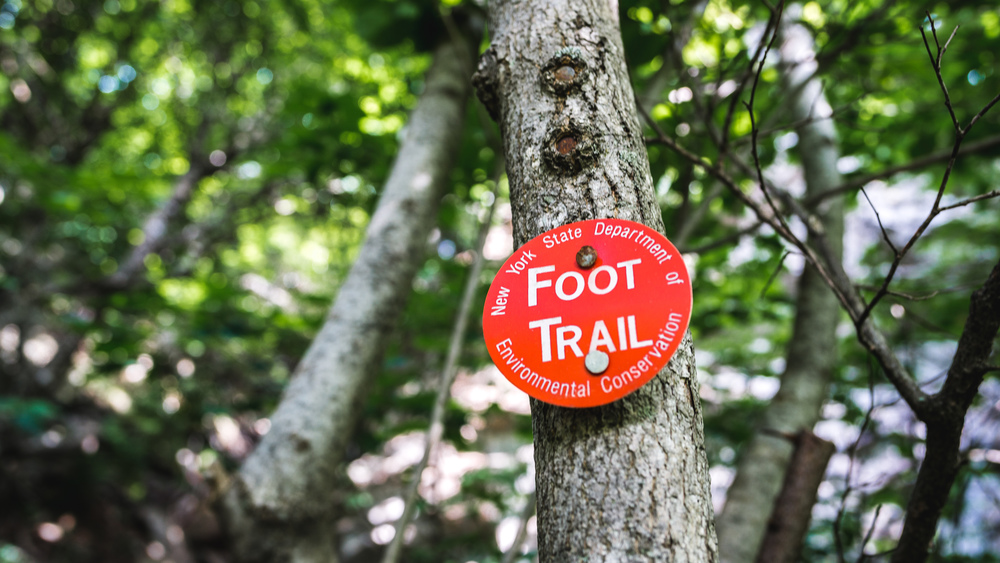
Starting from Prediger Road, the first few miles are quite easy: flat or with just a modest incline. For the first hour I did almost 5 miles (NB I did this as a run/hike, meaning anywhere it was not too steep or dangerous, I would jog/run). But soon enough, the climb proper to Indian Head will come up and it will be steep, no doubt about it.
In fact over the next 25 miles you will occasionally have to navigate near vertical inclines, using tree roots and rock features to haul your sorry ass up. But it’s all good fun.
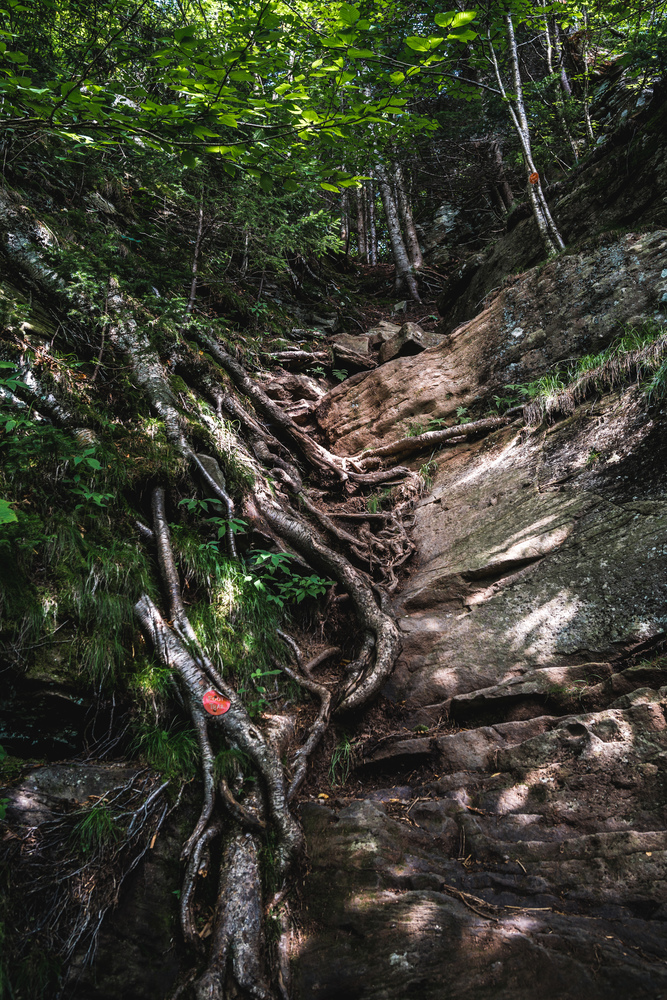
The Catskills have quite dense forest growing throughout and for almost all of the trail you will be hiking / running under a dense canopy, fairly oblivious to anything more than 100 yards off the trail. However, there will be occasional clearings, often rocky ledges, from which you get quite amazing, far-reaching vistas over the Catskills and even the Hudson river. There are really 3 main reasons why people do the Devil’s Path: i) the challenge, ii) the vistas, iii) the fact that you will bag 5 of the 35 Catskill High Peaks (defined as those over 3,500ft height). The 5 peaks you will get are: Indian Head, Twin, Sugarloaf, Plateau (all on the eastern half) and West Kill (on the western half). If you are OK to do 2 short-ish detours, you can claim 2 more: Hunter and Southwest Hunter.
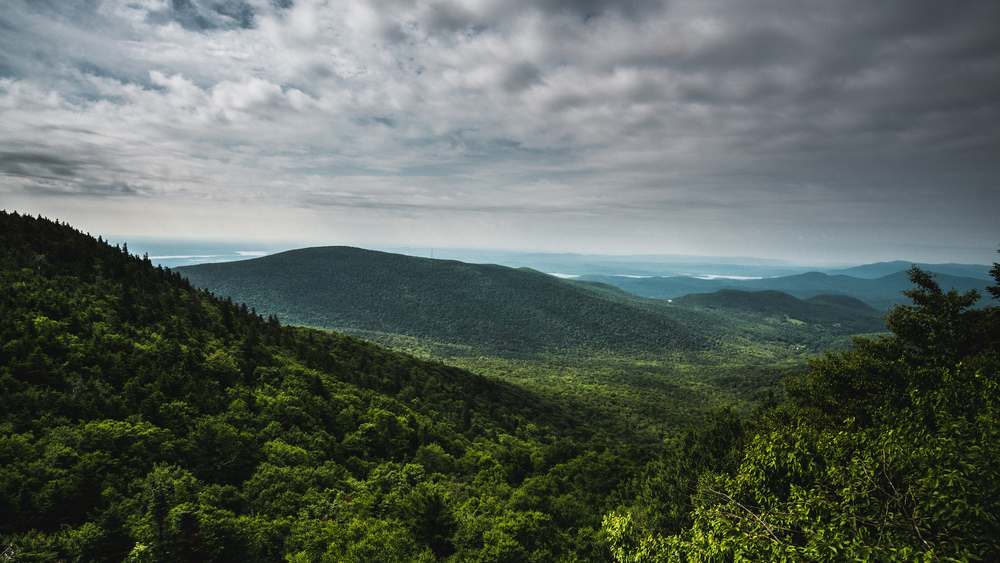
The Devil’s Path is so tough because you go up and down and up and down and up and down. It’s no easy ridge hike. Each and every mountain along the route will need to be climbed from the bottom up. Also, do not underestimate the descents as these can be quite technical. Especially when you come down Twin Mountain, you have to navigate quite a few steep sections and sharp rocks. This slowed my progress quite a bit — you simply cannot run downhill on that stuff.
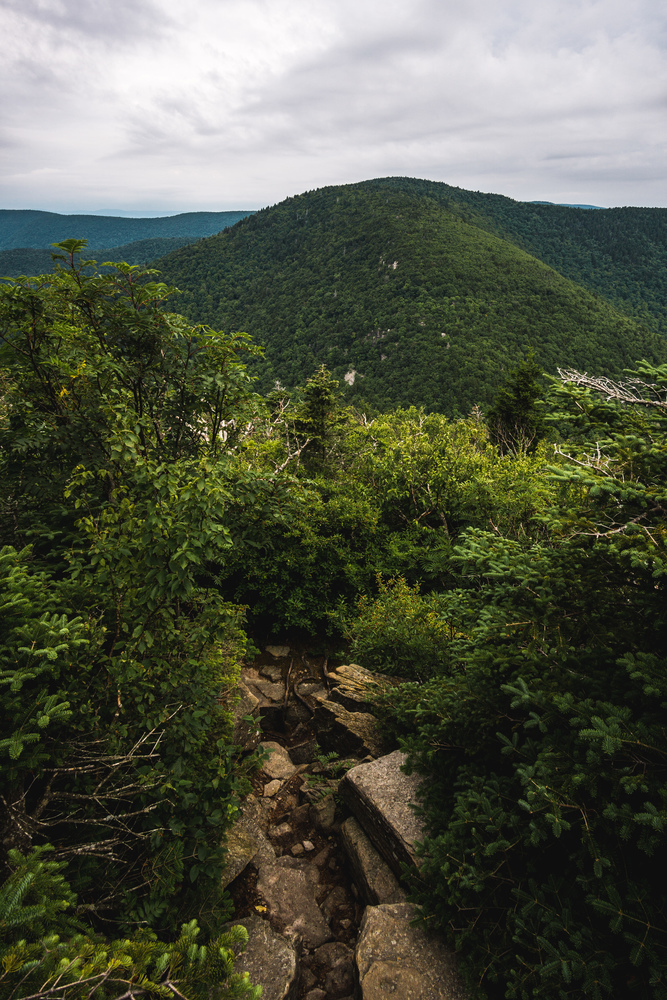
After Twin Mountsin, the trail takes you up the next Catkills Peak: Sugarloaf Mountain. If you have not felt the effort until now, you will certainly feel fatigue set in by the time you reach the summit of Sugarloaf. It’s another long, tough climb up and the descent from Sugarloaf is quite technical too with several sections of loose rocks and parts where you have to squeeze through in-between rocks. There was a solid rain shower as I made my way up Sugarloaf and this slowed my progress, since for the descents now, the rocks had become wet and slippery, so running was not always possible, even on the flatter sections.
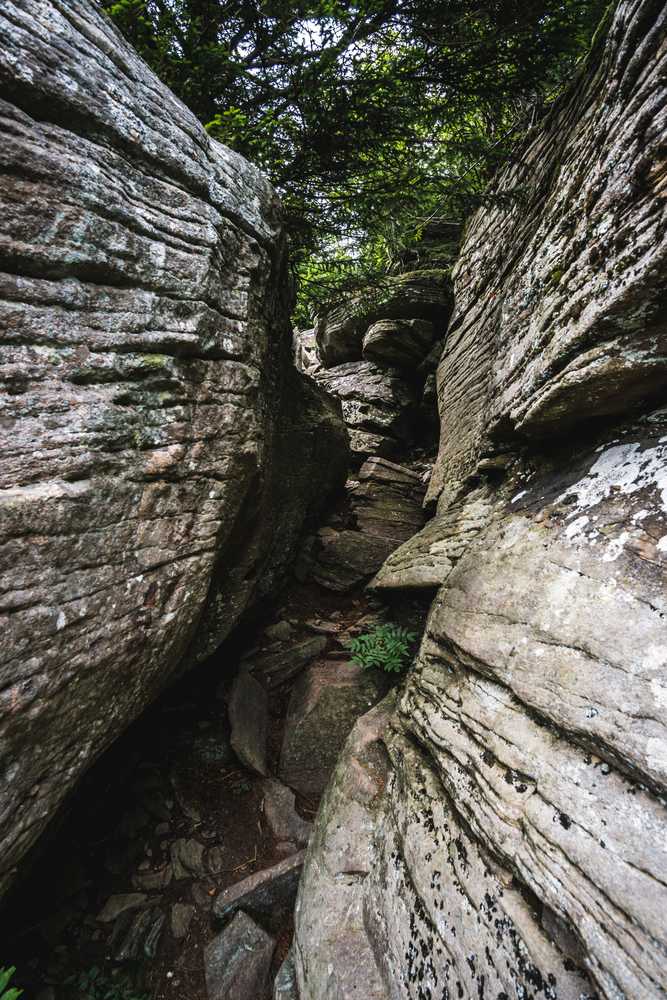
After Sugarloaf you still have to get over Plateau Mountain and once you come down this, you will cross a road: route 214 at Stony Clove Notch. Though you technically have done a bit over half of the distance by now (certainly the toughest bits are done and dusted now), mentally it feels as half-way since the road divides the Devil’s Path into its eastern and western halves. At Stony Clove Notch there is a small artificial lake, Notch Lake, and if you walk a bit down the road there would be a ranger station and Devil’s Tombstone campground. If you plan to make it a 2-day hike and not camp in the wilderness or a lean-to, then this would be your base. Some people also leave their car at the trailhead parking in Stony Clove Notch (note though that parking fees apply at this trailhead), since that gives them the option to pull out half-way.
Anyway, there is a water fountain, so be sure to fill up your water bottle, and, if you did not already have lunch at one of the overviews, here would be a nice enough spot too.
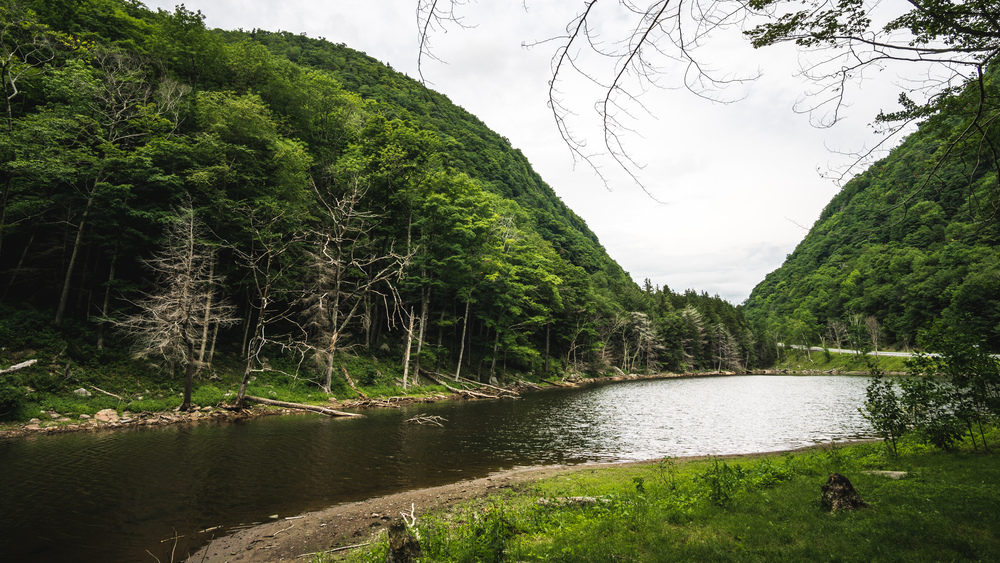
After this, you only have two more significant ascents to make: up the side of Hunter Mountain (you don’t go to the top, you cross the saddle between Hunter and Southwest Hunter; going to the top of Hunter mountain is a 1.6 mile one-way detour, so would add ~3.2 miles / 5km to your route; going to SW Hunter is a ~1 mile one-way detour) and up West Kill. There is a little side-peak to West Kill that you ascend after West Kill which barely looks noticeable on the map, but that last steep ascent comes a bit as a surprise, and you really are tired by then, so be aware it is there waiting for you at the end.
When I started going up Hunter Mountain, it started raining again and except for a short break in the downpour on top of West Kill, it kept raining for the rest of the day. Thankfully, this being July, it was fairly warm and so I did not suffer from hypothermia after becoming thoroughly soaked. Anyway, well prepared, I had spare dry clothes in my day pack, so could have changed if needed. The break in the rain was well-timed as it coincided with my arrival at one of the few viewpoints on the western half. The view from West Kill over the fog- and rain-swept Catskills was quite a sight to behold. I only encountered 3 other groups of hikers on the entire western part — the rain had kept people away (and 2 of those 3 groups were on their way down, after changing their plans due to the rain).
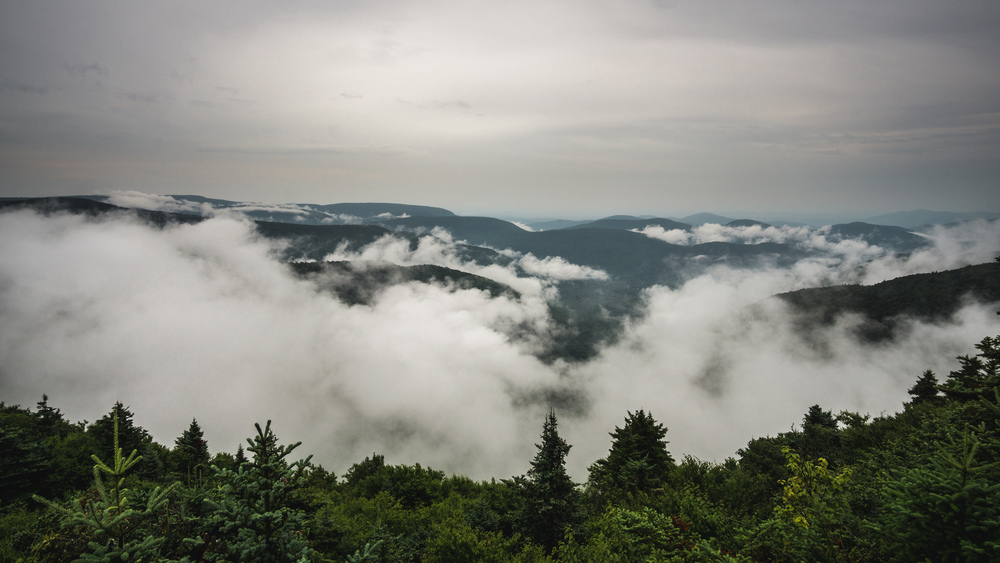
The descent from West Kills is fairly straightforward, though quite long. By this time I just wanted to get it over with: there were no more viewpoints, the forest is quite dense in this part and it was raining hard. The ground had become a wet mess and I slipped a few times — I still ran from time to time, but quite sparingly so; it was just too risky.
When I reached the car, I had been out on the trail for exactly 9 hours. I was a bit disappointed, as I thought I could have managed about 3 hours less, but it is a really tough route and the rain had prevented me from letting rip on the descents.
Final thoughts?
While super tough, I was a bit disappointed by the trail in the end. This is supposed to be the toughest, deadliest and generally most kick-ass trail in the eastern US; yet while some of the ascents are super steep and tough, there was less scrambling involved than I thought and I never once felt in real danger. I have done routes that involved scrambling on loose rock with a 600ft sheer drop to one side (e.g. the Snowdon Horseshoe loop), hence this slight anti-climax. Also, while a nice and rewarding hike, there are fewer viewpoints than you might expect — most of the time you are surrounded by dense bush. Don’t get me wrong: considering you cover 25 miles and numerous peaks, you will get your fair share of absolutely stunning vistas to behold, but you would have thought there would be more of those welcome breaks along the long, grueling hike. Most of the time you are “just” looking at trees, plants, rocks and the trail ahead of you. I am glad I have done it now finally, and as a day hike / run too, but I am not sure I will do it again any time soon (certainly not in its entirety).
Data files (click on the link, then download whatever format you prefer from the gpsies website):
One-way (drop you car at the final trailhead or arrange a pick-up for the end): http://www.gpsies.com/map.do?fileId=grixwiueoyzlljsg
]]>How long?
3 nights, 3 days
How many miles?
66 miles / 106km
How?
Trail running (or hiking) + hostels
Maps & compass required
Maps?
Ordinance Survey OL17 & OL18
Itinerary:
Llandudno Junction / Conwy -> Snowdon / Pen-y-Pass -> Swallow Falls / Betws-y-Coed -> Llandudnot Junction / Conwy
For accommodation, you can choose what you want: either carry a tent (in which case you probably want to start hiking for a tiny bit after you get to Conwy so that you are at least in the national park when you pitch your tent) or if you intend to run as I did this and hence want to travel lightly, make use of the excellent YHA hostels in Conwy, Pen-y-Pass and Swallow Falls / Betws-y-Coed (that’s why I chose these 3 places as the start and end points for the various legs). This also allows you to leave your pack in the Pen-y-Pass hostel when you do the Snowdon horseshoe loop early in the morning of the second day and hence really put the hammer down for that run (though keep in mind that you ran / hiked ~24 miles the previous day and have to run / hike another ~14 miles later the same day, followed by ~19 miles the next day).
Leg 1: Conwy -> Pen-y-Pass (~24 miles)
The first leg of the trip is the longest and toughest of the 3 legs. Basically from Conwy you run up the Carneddau range, then follow mostly along the ridge. In fact you just bag all the peaks: Drosgl, Drum, Foel Fras, Garnedd Gwenllian, Carnedd Llewelyn and Carnedd Dafydd. When I did this trip, conditions were quite bad on the Carneddau range: lots and lots of fog, rain and mist, but luckily not too much wind. Even navigating my path in that soup was mostly straightforward: for much of it you just have to follow a fence / wall!
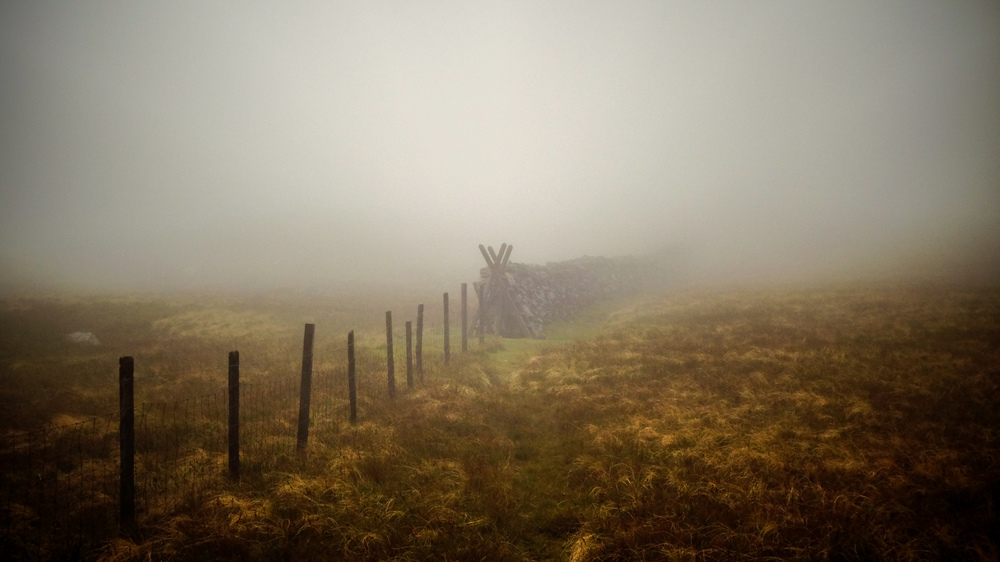
Since you are running along the ridge of the range, some of the undefoot conditions will be bar, broken rocks, particularly when you go over Foel Fras. This is eerily beautiful (especially in the fog) but can make for quite treacherous underfoot conditions, so be careful. This will also slow you down quite a bit.
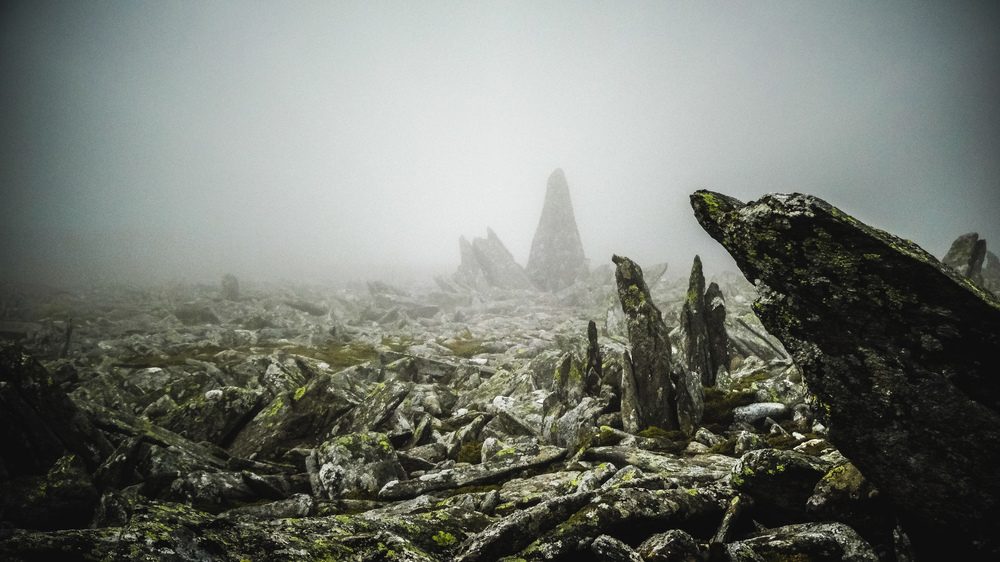
I a sure the views all along the Carneddau range are sublime, but I did not get to see much of it. However occasionally the fog would lift and I would get a glimpse of the impressive surrounding landscape.
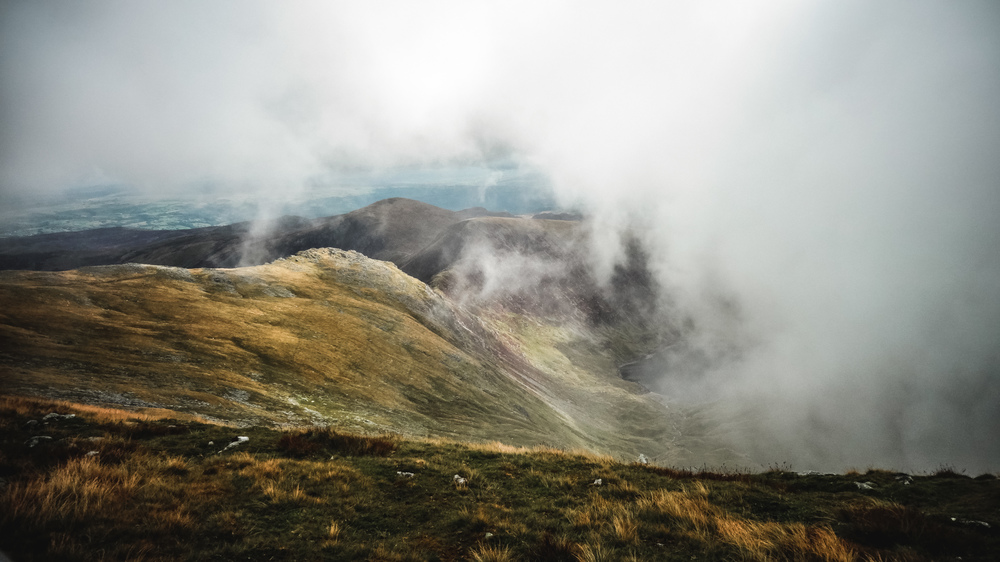
In the end, you need to come down from the Carneddau range and cross the Glyders. Going up the Glyders will be the toughest part of the run as you are well tired by then. The main path would take you down to the eastern end of the Llyn Ogwen lake. However, I would suggest taking the route that takes you over Cwm Lloer: the views you get coming down from there are well worth it (and I got lucky as the clouds finally cleared as I made my descent).
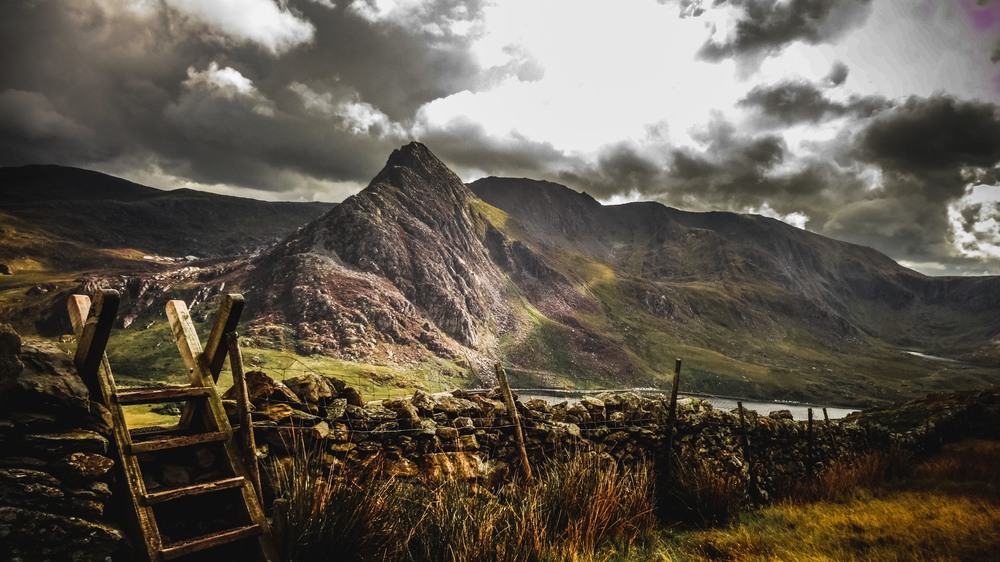
Either way, you go up on the other side of the lake, crossing the Glyders between Tryfan and Glyder Fach. From there you follow the Miners’ Track until you hit the road. Coming down the Miners’ Track you will get a splendid view over the Snowdon massif that will await you on the next day.
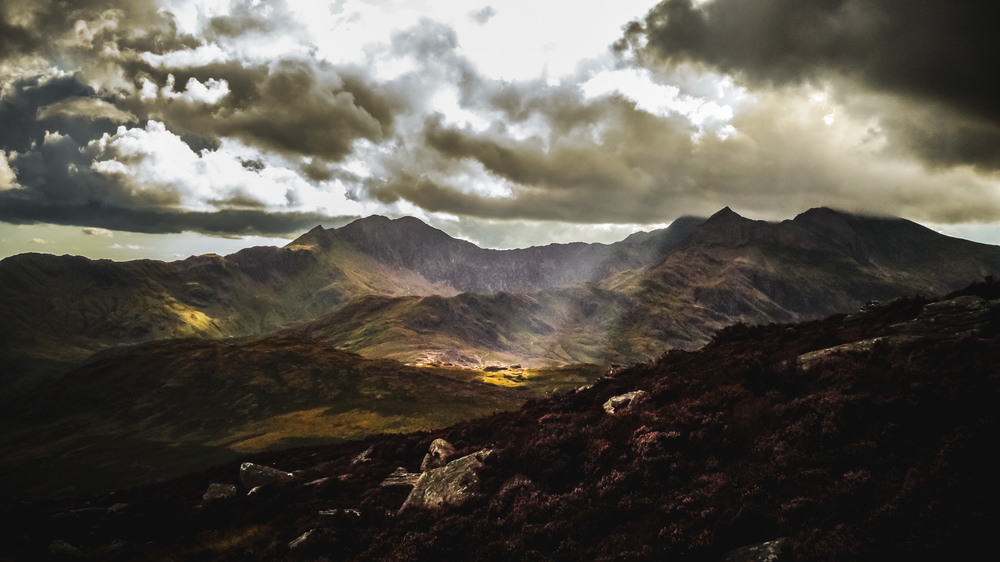
Once you hit the road, follow a small trail next to the road until you get to the Pen-y-Pass hostel. And then you get yourself a well deserved pint, dinner and rest!
Snowdon horsehoe loop (~8 miles)
You’ve spent the night at the foot of the highest mountain in Wales, so of course you want to go up to the top! I arranged meeting with a friend from my London running club, Tom, that morning at 5am outside the hostel. Together, and without any equipment except for a bit of water and a point-and-shoot camera, we set off to do the famous Snowdon horseshoe loop while the sun was just starting to get ready to rise. The very top of Snowdon was covered in clouds, but until we got there we were treated to a glorious sunrise.
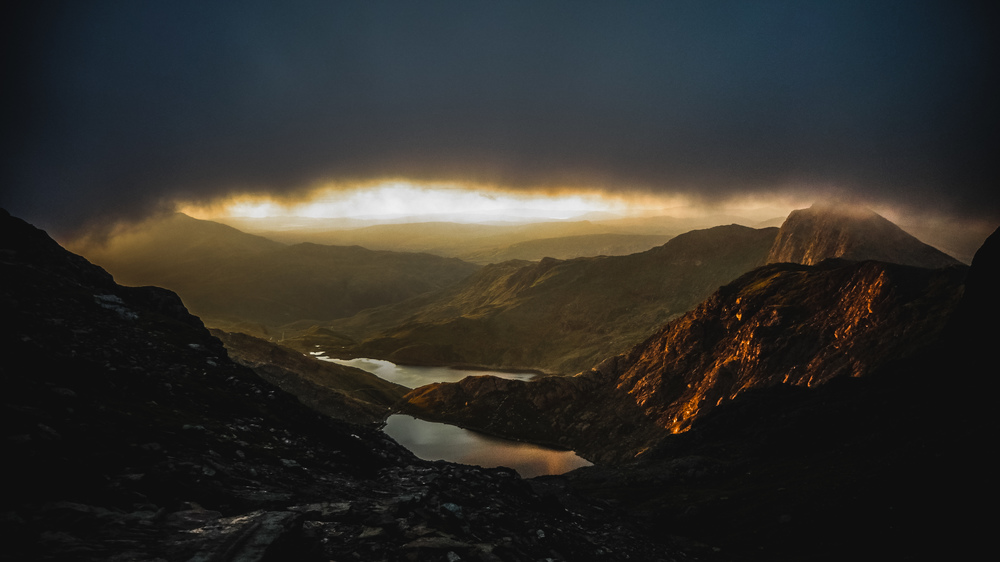
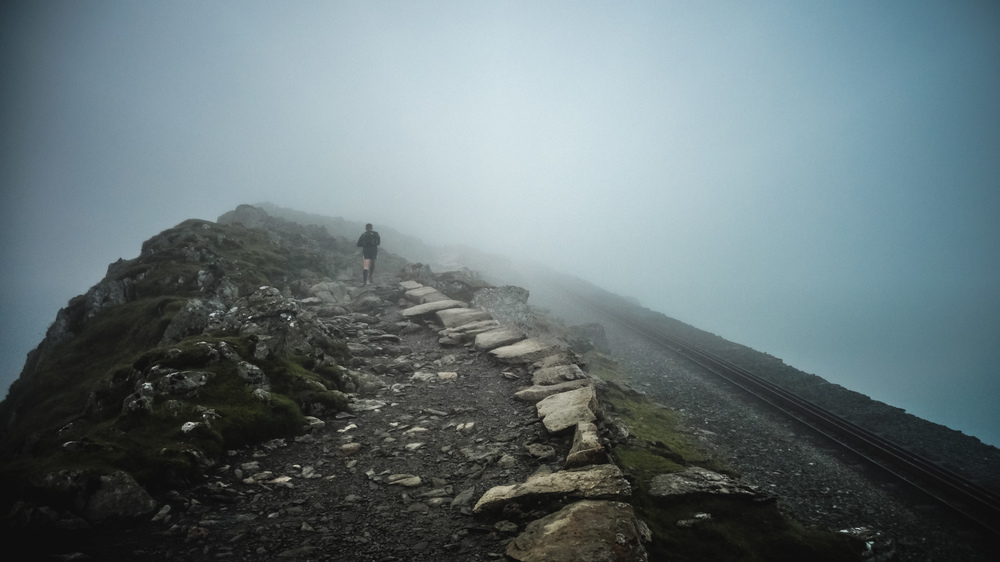
The ascent is tough and slow, but compared to the speed I managed with my backpack across the Carneddau and Glyder ranges we were going blazingly fast! We had hoped the clouds would clear when we got to the top, but this was not to be. Still eerily beautiful once we got to the top and we were pretty much the only people there at that time.
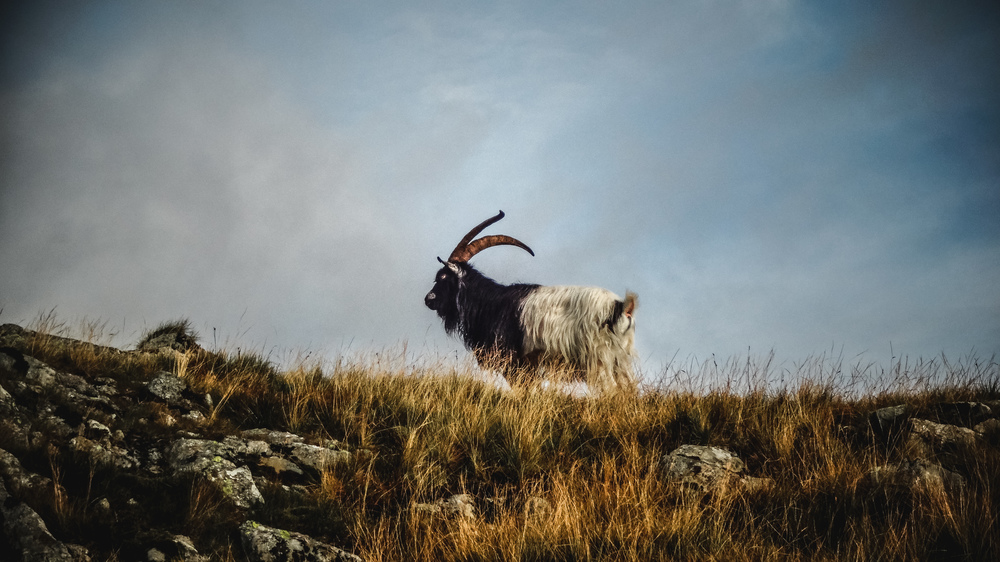
For the descent we chose a slightly shorter route that involved a bit of precarious scrambling next to a sheer cliff (probably a clean 600ft drop; the views are worth it though if you are not prone to vertigo!) before we hit easier terrain and well below 6min/mile pace for the descent. Only a grumpy looking mountain goat slowed us down for a bit.
After this I said good-bye to Tom and treated myself to a hearty breakfast at the youth hostel. Then I packed my stuff and set off on the second leg of the Snowdonia loop.
Leg 2: Pen-y-Pass -> Swallow Falls (~14 miles)
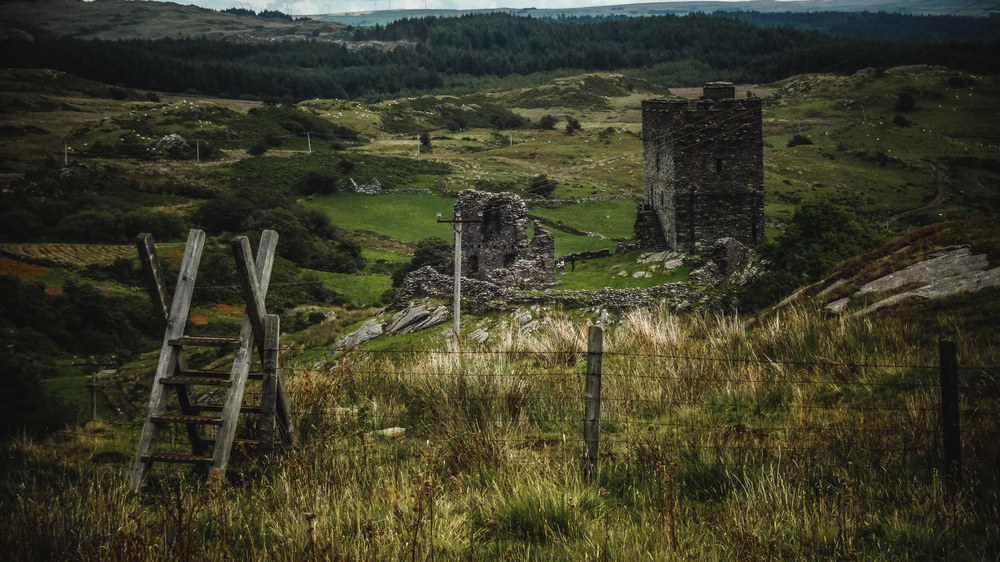
After the tough start to the day, the second leg of the actual loop is much shorter and easier than the first leg the day before. That said, you start by running down into the valley you can see from the hostel, then straight back up on the far end. After you cross that ridge you ran for a bit across an open meadow and then across a forest. When I did this run, half of this forest had been chopped down or blown over and it was incredibly muddy / boggy to cross. Hopefully when you go on a drier few days it will not be quite as bad. After that you run back onto an actual path / trail and follow that past the ruins of Dolwyddelan Castle. You can actually go inside and up the tower, so I suggest you do that and rest your legs a bit and maybe have some food from your pack.
From there I followed the trail some more, but after a while you get to a large open marshland area and, at least when I ran the route, there is no way to see the trail — it’s time to get the compass out. The footing here is quite treacherous and I did not manage more than a fast walk. However you can take comfort that once you crossed this, you will get back onto the trail and from there it is easy to find your way to the hostel near Swallow Falls.
You can visit the falls, but there is a turnstile where you have to pay small entrance fee. When I did this trip, the turnstile was broken and I (and other people too) had to jump the gate.
Compared to Pen-y-Pass the hostel here is much more basic and you will need to get your food in the hotel pub next to it.
Leg 3: Swallow Falls -> Conwy (~19 miles)
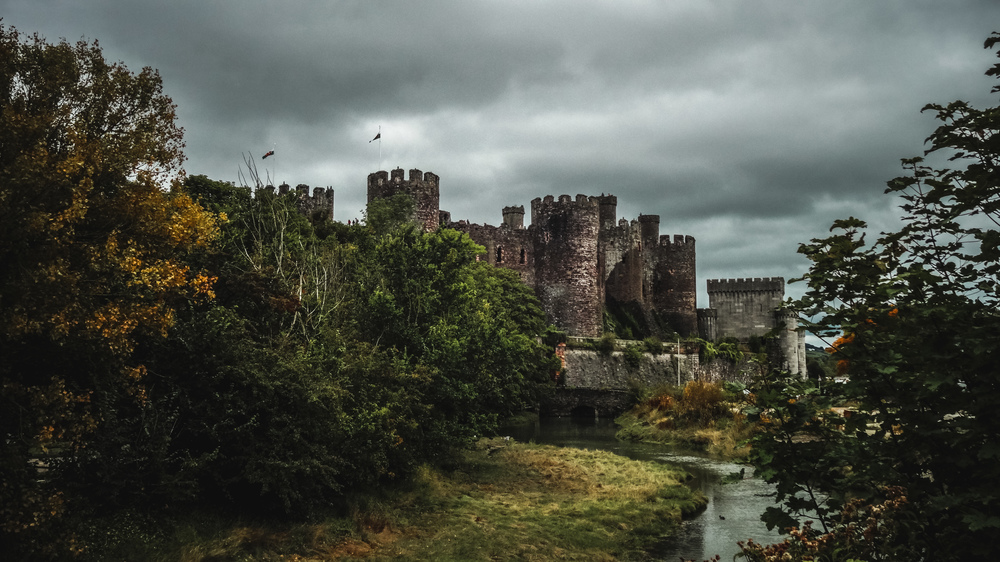
Last day! The start of the route for the last leg is quite delightful: you start by going up the hill on the other side of the river that goes through Swallow Falls, then make you way along a forest road & trail to Llyn Bodgynydd and then Llyn Geirionydd. Finally you find your way to the village Trefriw. From here on I was a bit concerned to be back in time for my train from Llandudno Junction and decided to run mostly along road and to run through the different Welsh villages and towns along the way. Alas this sounded much better when I planned this than it was. Some of the road running is really not that exciting (especially on a grey, overcast day with occasional rain showers). It’s probably tricky to find a route that goes through the national park that is not a repeat of the route from leg 1, but feel free to try. That said it is still a nice run and you really feel happy when you see the ramparts of Conwy castle again.
What would I do differently now that I’ve done this
I’d do this loop again on any bank holiday weekend. However there are probably 2 things I’d try to improve. For one, I would try to change the route of the third leg so that it is less on the road; it’s not the nicest stretch of road running you can find (though you can do a lot worse – believe me!); the only trouble is to find an easily navigable route through Snowdonia National Park without repeating parts of leg 1… Also it will add distance to leg 3, which after two tough preceding days is probably not what you want. For another, I’d probably try to avoid that open marshland on leg 2 — just from studying the map it was not clear that the conditions were going to be so tough on that stretch.
Notes
All pictures in this post were shot with small point-and-shoot camera, hence their much less than professional appearance.
Watch out for cows: many a farmer lets their stock graze freely on park land or land adjacent to the park that you come through. This is particularly true for the third leg. I was chased by one bull on one occasion and a cow watching her calf on another one.
Data files (click on the links, then download whatever format you prefer from the gpsies site):
Leg 1 (Conwy -> Pen-y-Pass): http://www.gpsies.com/map.do?fileId=qlldmpubvzpotsxl
Snowdon horseshoe loop: http://www.gpsies.com/map.do?fileId=yfxfexnzlgtxetav
Leg 2 (Pen-y-Pass -> Swallow Falls): http://www.gpsies.com/map.do?fileId=bqkczubkvxvhdqzn
Leg 3 (Swallow Falls -> Conwy): http://www.gpsies.com/map.do?fileId=ropysbhzkunpkzfi
Complete route: http://www.gpsies.com/map.do?fileId=hrgesegtiwcgxckb